As of February 2017, Magnus and Konswan are no longer together.
Konswan has moved to Lajes, on the other side of Flores Island.
The boys, Odin and Mitra, spend their time equally between both parents.
Flores Permaculture is still going strong.
Magnus met the love his life in the Autumn of 2018 and she has joined him in his lifelong project.
Thursday, February 13, 2020

Monday, May 4, 2015
New Blog is Operational
Now that we are no longer Magnus and Konswan only, it seems like a good time to start a new blog. We will leave this blog active and perhaps post to it on occasion. However, we feel that Facebook is a better venue for our personal life. We plan to make the new blog more project oriented and less personal. Our philosophy since beginning this project was to plant as many "invasive edibles" as possible to minimize our work load while still being a highly productive farm, as it turns out Bill Mollison came up with this idea in the 70s and coined it Permaculture for Permanent Agriculture. Rather than reinvent the wheel, we are happy to use his terminology and reach a larger audience that is already familiar with so many of our ideals and practices. Please take a look and let us know what you think.
Our new and updated blog can be found on the following link:
Our new and updated blog can be found on the following link:
Monday, October 6, 2014
Early Autumn Harvest Photos
With two children in our lives, we are finding it difficult to find much time for the blog. Please forgive the brief posts, and enjoy the photographs.
Most of the photos are from our Zone 1 gardens to use Permaculture lingo.
This time of year, the peppers are finishing up and ready to be harvested.


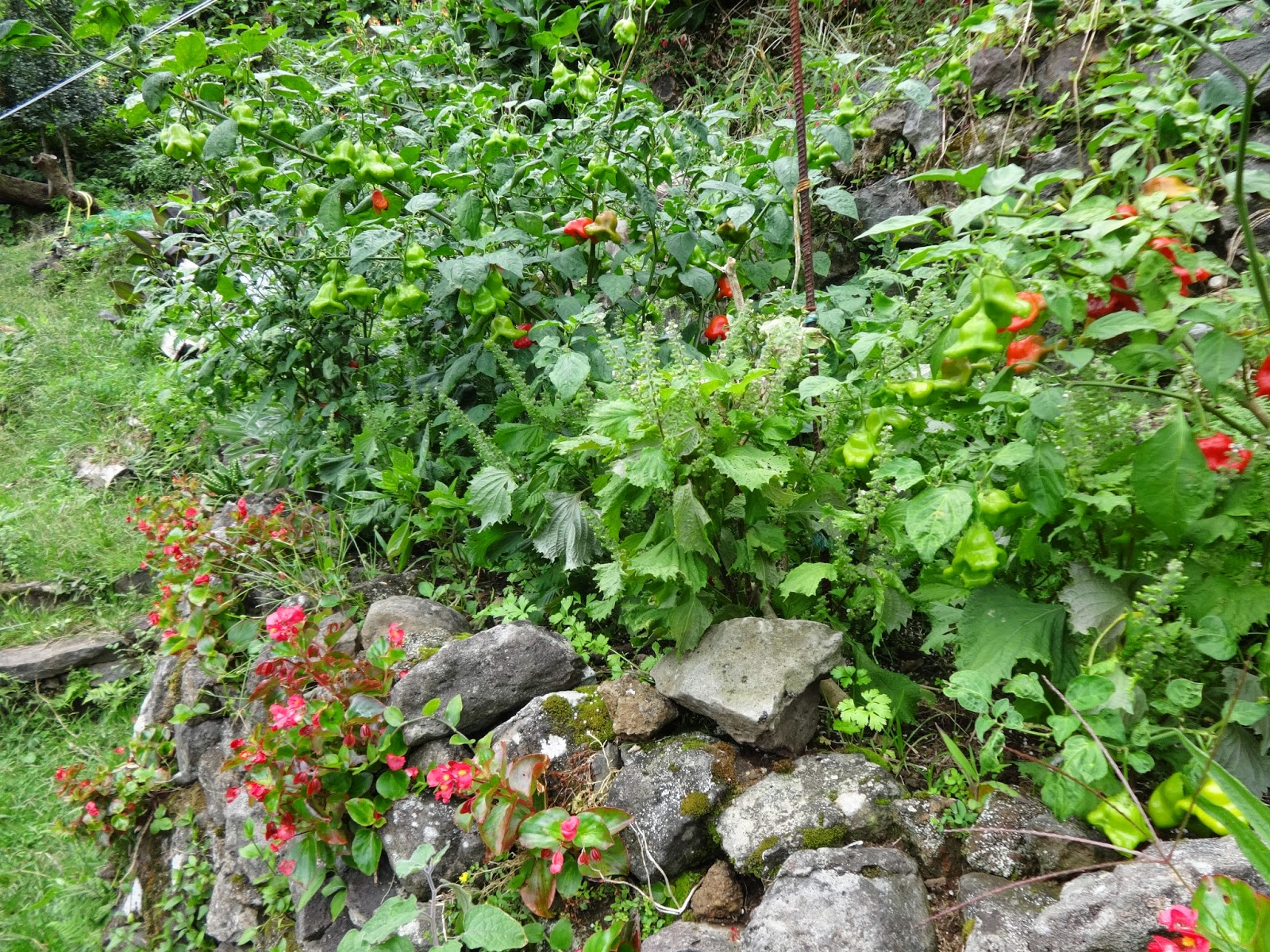


Most of the photos are from our Zone 1 gardens to use Permaculture lingo.
This time of year, the peppers are finishing up and ready to be harvested.
Odin is helping to process a Luffa Gourd.
http://en.wikipedia.org/wiki/Luffa
Shiso has been allowed to self seed and now is growing in most of our vegetable gardens.
Peppers, Aubergines, and Shiso out compete the weeds and taste great.
We have our composting toiled fully operational now and in daily use, creating amazing HOT COMPOST.
Steve and Barbara lent a helping hand this summer and we closed off another section of cleared jungle for a chicken run. With 30 birds, the first run is a dust field now and needs to be replanted with a Nitrogen fixer, maybe alfalfa for the chickens to eat.
More Aubergines, yum-yum!
Well that is it for now. More to come as time allows.
Monday, July 21, 2014
Update from the Flores Fruit Farm Summer 2014
It has been quite some time since we have updated the blog. In that time we have done the projects posted below.
We are without a vehicle or phone line, so we do not have the opportunity to use the internet often. We will try to write more explanatory blogs as time allows, in the mean time enjoy the photos of our project.
Mitra will be turning 1 and Odin will be 3 this August Both boys are thriving with sunshine and love and healthy foods. They don’t seem to mind living in a construction zone.

The Hydro-Electric project has been functional for one year now. It is not completed, but works fantastically as is. In time we will maximize its output.

The view from our backyard. So much concrete work and terraforming yet to do.
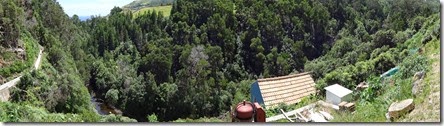
Our primary banana patch is expanding yearly where jungle stood before.
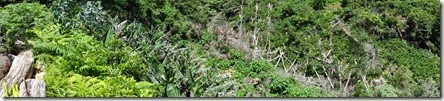
We are getting lovely bunches of fresh fruit more frequently as the roots dig into the rich valley soil and the sun penetrates where forest shadowed before.


The citrus orchard with limes and sweet oranges that is home to our chicken flock is completed fenced now. This allows us to gather ALL the eggs that are laid daily.

The chicken manure feeds the fruit trees and the chickens eat the weeds and pests for us. On average we gather 6 eggs daily.

We are doubling the size of our flock this year to replace old chickens as needed. Soon we should have a surplus of eggs to store for winter.

The road to our house is getting a bit bushy without traffic. We decided to “ring-bark” the remaining large Eucalyptus trees rather than risk dropping them.

Our front yard with an amazing view of the Atlantic Ocean.

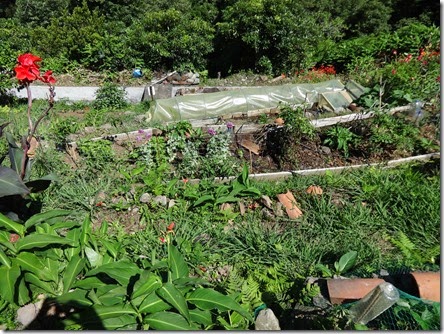
The primary vegetable gardens making use of the stone walls we hand built so long ago.
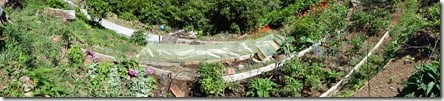


Our house and front yard.

Our lemon tree and grapefruit are producing fruit regularly now after we planted them in 2008.

We want to start a new blog site, as we are so much more than ‘Magnus and Konswan’ at this point. Whenever time allows us to create the new site we will post a link to the new page.
For those who helped us resolve the driving license fiasco, THANK YOU!
Magnus now has a Portuguese drivers license and no problems with the Portuguese police after paying a 200 Euro fine for driving with an United States Drivers License for over 90 days.
We are without a vehicle or phone line, so we do not have the opportunity to use the internet often. We will try to write more explanatory blogs as time allows, in the mean time enjoy the photos of our project.
Mitra will be turning 1 and Odin will be 3 this August Both boys are thriving with sunshine and love and healthy foods. They don’t seem to mind living in a construction zone.

The Hydro-Electric project has been functional for one year now. It is not completed, but works fantastically as is. In time we will maximize its output.

The view from our backyard. So much concrete work and terraforming yet to do.

Our primary banana patch is expanding yearly where jungle stood before.

We are getting lovely bunches of fresh fruit more frequently as the roots dig into the rich valley soil and the sun penetrates where forest shadowed before.


The citrus orchard with limes and sweet oranges that is home to our chicken flock is completed fenced now. This allows us to gather ALL the eggs that are laid daily.

The chicken manure feeds the fruit trees and the chickens eat the weeds and pests for us. On average we gather 6 eggs daily.

We are doubling the size of our flock this year to replace old chickens as needed. Soon we should have a surplus of eggs to store for winter.

The road to our house is getting a bit bushy without traffic. We decided to “ring-bark” the remaining large Eucalyptus trees rather than risk dropping them.

Our front yard with an amazing view of the Atlantic Ocean.

The primary vegetable gardens making use of the stone walls we hand built so long ago.


Our house and front yard.

Our lemon tree and grapefruit are producing fruit regularly now after we planted them in 2008.

We want to start a new blog site, as we are so much more than ‘Magnus and Konswan’ at this point. Whenever time allows us to create the new site we will post a link to the new page.
For those who helped us resolve the driving license fiasco, THANK YOU!
Magnus now has a Portuguese drivers license and no problems with the Portuguese police after paying a 200 Euro fine for driving with an United States Drivers License for over 90 days.
Friday, February 15, 2013
Fruit for Life, Departing from a Flores Tradition
The staple crop for our island is the tried and true potato (Solanum tuberosum). This starchy tuber originated in the Andes mountains and was cultivated in South America for thousands of years prior to the Spanish arrival in the 16th century. The Spanish recognized the commercial importance of this crop and disseminated the tubers across their empire and eventually throughout Europe. Small scale cultivation could be easily achieved with minimum effort. However, in order to produce enough food in the growing season to last throughout the long winters, a gardener requires large areas of flat land that easily accessible to a plow. Today Flores farmers minimize the amount of pesticides and fertilizers used on their crops for home consumption, preferring barnyard muck as a top dressing prior to the first plowing of the land. Most families on our island have a sizeable flat area directly beside or behind their homes that is dedicated to the yearly potato crop.
Because of the relative abundance of this crop, large sacks can be purchased at harvest time for a small sum. After harvest, if the potatoes are dried correctly and stored in a cool, dark, and dry location they will last the family until the next season’s crop is ready for harvest. If the gardener does not store them correctly then the crop will rapidly deteriorate into a rotting mass of bug-infested goo. Although we are able to purchase potatoes at a fair price, we are striving to fulfill our goal of self-sufficiency and we do not want to build a dependence into our yearly survival necessities.
Since our land has no naturally occurring flat areas larger than a table top, we have spent years building retaining walls built directly into the bedrock or clay layer of our mountainside. Our gardens are inaccessible to a plow and are hand dug and weeded annually. This precious space is created with a high cost in man-hours and is utilized with scrutiny. We do grow a small plot of potatoes yearly, but this is for flavor in summer salads rather than a staple crop.
We realized that we needed to find a staple food crop that we could maintain on our own land and with our limited tools and accessibility. After researching the tomes of digital wisdom available to our enlightened generation, we found ourselves drawn to Musa Sapientum, the banana. This amazing herb has been cultivated for tens of thousands of years in Asia, even being noted by Alexander the Great when he explored India. Both Konswan and I, being natives to the tropics, were thrilled at the prospect of building are very own ‘Banana Republic’ on our little mountainside farm.

Further research showed that there were hundreds of cultivars available from around the world. Although tempted to try some of the giant meter-long bananas or the bright red and purple varieties, we decided to acquire local island clones. This decision was made on both financial, as well as practical reasons. The banana can be plagued by soil fungus, and our sub-tropical island is a fungal paradise. We reasoned that local varieties, although having small fruit, would produce more offspring in the long term since they were already acclimated to Flores weather and soil conditions. Also, the cost to import other exotic cultivars was beyond our budget constraints. And so, we found a source of local clones and in exchange for a day’s labor on another man’s farm, I returned home with a pickup truck full of suckers (banana clones that rise from the root mass of existing plants).
Phase 0, getting geared up and motivated to tackle 50+ years of jungle.

I have been steadily clearing the jungle from our farm for the past few years. The process begins with clearing the underbrush with a machete, so that I can safely navigate the area with a small chainsaw. My favorite chainsaw for land-clearing is the ‘Stihl MS 180’, as it is lightweight, durable and small enough to use in the tight spaces of overgrown jungle. After clearing the underbrush, then the small trees (under 30 cm in diameter) can be cut at ground level and have their limbs removed. The trunks are cut into manageable lengths and laid in piles to dry, while the limbs are piled high to allow the leaves to naturally mulch the forest floor. When all the small trees are felled and organized, then the large chainsaw is brought into play. My choice is the ‘Stihl MS 660’ for felling trees from 35 to 80 cm in diameter. The large trees are dropped, sometimes using a winch to control their fall radius more precisely. I generally want to keep the large trees near to the road so that I can haul them out later to be used for lumber. After all the trees and underbrush have been cleared, then they are allowed to sit for a year to dry. The following summer, a massive bonfire is made that consumes all the wood and destroys new weeds that have begun to sprout in the newly created garden space. This thick layer of charcoal is quickly distributed across the area with a rain shower and the site is ready for planting.
Phase I, after exploring the layout of the land and finding an appropriate site for future gardening, the underbrush must be cleared using a machete.

Phase III of clearing, stacking the small trees to dry in the sun, prior to the bonfire that will add nutrition to the soil.

Having already done these steps the previous year, I took my new suckers and put them to bed in the rich black earth of our mountainside. The remaining tree roots often obscure my choice of locations for planting which aggravates my orderly grid-oriented self. I have learned to embrace the Zen aspect of mountainside gardening and allow the spacing of my banana plants to vary according to the dictates of the terrain. One of the added bonuses to the propagation of Musa sapientum is that they can outgrow the invading weeds and thereby shade the ground below them from future weed germination. In this way, I have an ally in my never ending fight against the invasive and toxic plants that were naively introduced to our island over the years. In the future I can use the banana thickets as an edible wind break and place fragile fruit trees in the center of the patch. Every year, I must remove the new banana suckers and transplant them into newly cleared land; in this way I have an ever expanding ring of weed free and useful garden space!
Phase IV, the planting of the Musa Sapientum clones into the newly cleared mountainside.
Before and After Photos


This year we have been able to harvest our first bunches of bananas. We are experimenting with various recipes from around the world that use green or unripe bananas in place of potatoes in their cuisine. Odin loves the small fruits both ripe or cooked green, which is lucky for him, since he will be eating them for the foreseeable future. I cannot help but sing the ‘Tally me Banana” song whenever I go out to harvest a new bunch.
Phase V, Harvesting of green bananas to ripen inside or be eaten green.

As the herbs grow larger root masses and have ample time to mature, the bunches will develop with more fingers (individual fruits) per hand (groupings of fruits). We are off to a good start though with a fresh supply of ripe and green bananas during the cold days of February. We hope to have an over-abundance in the future to enable us to trade within the village for potatoes, as well as to sell in the local shops that usually import bananas from Central America rather than sell local organically grown produce.

The final advantage we find in growing Bananas rather than potatoes lies in the issue of storage. Whereas potatoes are harvested at one time during the year and stored for later consumption; Banana plants have a staggered fruiting period. This means that we always have a fresh supply of complex carbohydrates on demand year round, still alive and full of Chi! We need only harvest what we need for the week and leave the other bunches to ripen for a sweet desert treat.
Newly transplanted suckers are thriving on our sunny mountainside after the large Eucalyptus trees have been felled and the jungle underbrush cleared.


In total, we have over 100 Banana plants thriving in several patches throughout our properties. Clearly visible in the foreground are the massive trunks from the trees that were felled in previous years; in the distance you can see the invading jungles awaiting their turn with my machete!

Wednesday, January 23, 2013
Reflecting on Six Years of Homesteading
My wife, Konswan, and I arrived on Flores Island during the final days of January, 2007, with $7000 dollars and ambitious dreams. Neither of us had any construction experience nor a forestry background. We had kept small gardens and done several ornamental landscape projects over the ten years we had rented houses together in the United States. It is a massive understatement to say we were not prepared for the task that lay ahead of us, and yet we felt we had to take the risk if we wanted to make the world a better place. We heard that small and quiet voice within ourselves clearly state to trust that all would be well, even if we could not understand or anticipate how. We made the leap of faith and began the restoration of an abandoned stone house with orchard space. A tall order for two dreamers who possessed years of higher education, but no practical experience beyond weekend camping trips in North America’s National Forests.
We had read the teachings of the worlds’ great philosophers and prophets, and listened to lectures from this century’s equivalents, however nobody was actually applying the ideals set out by these socially accepted wise-men. That ideal is to turn away from the hollow and fleeting pleasures of the physical body and to embrace the spiritual path that unfolds when we make our relationship with God of the utmost importance--a process of simplification from outside distractions that encourages a peace and calmness as we become one with our creator. And so, with a sense of destiny that only faith could provide, we jumped into the project of converting a ruined stone house situated in the middle of an abandoned fruit orchard in the middle of the Atlantic on the Azorean island of Flores.
Flores Island had been colonized in 1475 by the Flemish initially, but the colony was promptly abandoned when the long winters, comprised of endless rain storms and intense hurricane-force winds, induced the inhabitants to move to other islands within the Azores group. Later, the Portuguese successfully colonized Flores Island and over 400 years the population stabilized at 12,000. The isolation of Flores from the rest of the world forces the island’s residents to become ‘Island Sufficient’ or to perish. Ships bringing supplies are always eagerly awaited, but often are delayed, once up to seven years! After the Salazar dictatorship crumbled in 1974 during the Revolution of the Carnations, the population was free to travel abroad. Three-fourths of Flores’ inhabitants left over the next years, leaving the remaining 4000 inhabitants with much free space, but few economic opportunities.
Over the past six years we have experienced a mixed bag of tremendous good fortune and spectacularly bad luck. We have done our best to capitalize and maximize on our good fortunes, while ‘keeping the faith’ when dread and fear threaten to paralyze us during the disasters. We have learned to find the border between Fear and Prudence, a vast grey area that can lead to endless indecision if not explored and mapped.
Now we are nearly finished with our large and dangerous construction jobs. We are eagerly awaiting the birth of our second child in August 2013, while dreading the time constraints that will accompany such a large responsibility. Now we need to finish building a bathroom, then start installing a kitchen and a children’s bedroom within the protective shell we constructed over the last years. We are nearly finished installing the hydro-electric system that will generate all our electrical needs and allow us to have lights at night and keep a chest freezer and have a clothes washing machine. Hopefully these time saving devices will allow us to focus on our children and also to allow us the time to pursue our writing careers.
At this time, we find ourselves in a precarious position with the local police owing to not having a Portuguese drivers license. The process to obtain a valid license is simple, but requires that Magnus return to Arizona, USA, to obtain the necessary documents. In order to accomplish this, we must raise 1500 euros for air travel. The documents themselves cost only 8 euros, but they cannot be sent via mail, they must be applied for and received in person only. We now have a road to our house and two vehicles, but we have not been able to use them for over a year now, since the police explained the law to us. Without the use of a vehicle, the isolation of our farm becomes like a prison that we cannot escape, especially during inclement weather, which accounts for November through May. In addition to the prohibition to drive, our road is not passable to vehicles that would normally deliver construction materials. So we have to drive our 4X4 jeep to pick up materials. We cannot buy nor sell the necessary goods that would allow us to thrive in our endeavors. As our son, Odin, matures, it becomes increasingly important that he has the opportunity to interact with the many other children of our village and learn the necessary social skills, but without the option of a safe, dry and wind-free vehicle in which to travel to his friends homes, he too is a prisoner in our beautiful home. We have the vehicle but need funds to get the drivers license that allows us to legally drive in Portugal.
We are on the verge of fulfilling our goal of being a self-sufficient farm. When the electricity project is complete we will have the free time to write articles or even short stories for publication. The fruit trees are producing this year and will double their production yearly with minimal maintenance. The gardens are built and only need to be weeded and planted every year. Our chicken flock is healthy and producing eggs and offspring yearly. The road we built is functional with four-wheel drive vehicles, a limitation in many ways, but better than having no road access to our house in the middle of the forest. We have utilized the gift-monies that our friends and families have donated to us. The monies have allowed us to double the size of our home and buy a 4x4 jeep; as well as double our land holdings that allow for our new road and, to raise enough vegetables to feed us year round, and to expand the orchard space in the coming years. Now we find that we need just a little more funding to get through the next year, and we humbly turn to the hundreds of readers that read our blog monthly. If you believe in a future that involves small families living harmoniously with nature and you believe in the power of faith to motivate people into a closer relationship with the Creator and Creation, whatever your faith may be, and if you believe that the world could be made a better place by individuals making difficult and mindful decisions then please take the time to make a small donation using the button at the top of our Blog. Thank you for your time and support.
We had read the teachings of the worlds’ great philosophers and prophets, and listened to lectures from this century’s equivalents, however nobody was actually applying the ideals set out by these socially accepted wise-men. That ideal is to turn away from the hollow and fleeting pleasures of the physical body and to embrace the spiritual path that unfolds when we make our relationship with God of the utmost importance--a process of simplification from outside distractions that encourages a peace and calmness as we become one with our creator. And so, with a sense of destiny that only faith could provide, we jumped into the project of converting a ruined stone house situated in the middle of an abandoned fruit orchard in the middle of the Atlantic on the Azorean island of Flores.
Flores Island had been colonized in 1475 by the Flemish initially, but the colony was promptly abandoned when the long winters, comprised of endless rain storms and intense hurricane-force winds, induced the inhabitants to move to other islands within the Azores group. Later, the Portuguese successfully colonized Flores Island and over 400 years the population stabilized at 12,000. The isolation of Flores from the rest of the world forces the island’s residents to become ‘Island Sufficient’ or to perish. Ships bringing supplies are always eagerly awaited, but often are delayed, once up to seven years! After the Salazar dictatorship crumbled in 1974 during the Revolution of the Carnations, the population was free to travel abroad. Three-fourths of Flores’ inhabitants left over the next years, leaving the remaining 4000 inhabitants with much free space, but few economic opportunities.
Over the past six years we have experienced a mixed bag of tremendous good fortune and spectacularly bad luck. We have done our best to capitalize and maximize on our good fortunes, while ‘keeping the faith’ when dread and fear threaten to paralyze us during the disasters. We have learned to find the border between Fear and Prudence, a vast grey area that can lead to endless indecision if not explored and mapped.
Now we are nearly finished with our large and dangerous construction jobs. We are eagerly awaiting the birth of our second child in August 2013, while dreading the time constraints that will accompany such a large responsibility. Now we need to finish building a bathroom, then start installing a kitchen and a children’s bedroom within the protective shell we constructed over the last years. We are nearly finished installing the hydro-electric system that will generate all our electrical needs and allow us to have lights at night and keep a chest freezer and have a clothes washing machine. Hopefully these time saving devices will allow us to focus on our children and also to allow us the time to pursue our writing careers.
At this time, we find ourselves in a precarious position with the local police owing to not having a Portuguese drivers license. The process to obtain a valid license is simple, but requires that Magnus return to Arizona, USA, to obtain the necessary documents. In order to accomplish this, we must raise 1500 euros for air travel. The documents themselves cost only 8 euros, but they cannot be sent via mail, they must be applied for and received in person only. We now have a road to our house and two vehicles, but we have not been able to use them for over a year now, since the police explained the law to us. Without the use of a vehicle, the isolation of our farm becomes like a prison that we cannot escape, especially during inclement weather, which accounts for November through May. In addition to the prohibition to drive, our road is not passable to vehicles that would normally deliver construction materials. So we have to drive our 4X4 jeep to pick up materials. We cannot buy nor sell the necessary goods that would allow us to thrive in our endeavors. As our son, Odin, matures, it becomes increasingly important that he has the opportunity to interact with the many other children of our village and learn the necessary social skills, but without the option of a safe, dry and wind-free vehicle in which to travel to his friends homes, he too is a prisoner in our beautiful home. We have the vehicle but need funds to get the drivers license that allows us to legally drive in Portugal.
We are on the verge of fulfilling our goal of being a self-sufficient farm. When the electricity project is complete we will have the free time to write articles or even short stories for publication. The fruit trees are producing this year and will double their production yearly with minimal maintenance. The gardens are built and only need to be weeded and planted every year. Our chicken flock is healthy and producing eggs and offspring yearly. The road we built is functional with four-wheel drive vehicles, a limitation in many ways, but better than having no road access to our house in the middle of the forest. We have utilized the gift-monies that our friends and families have donated to us. The monies have allowed us to double the size of our home and buy a 4x4 jeep; as well as double our land holdings that allow for our new road and, to raise enough vegetables to feed us year round, and to expand the orchard space in the coming years. Now we find that we need just a little more funding to get through the next year, and we humbly turn to the hundreds of readers that read our blog monthly. If you believe in a future that involves small families living harmoniously with nature and you believe in the power of faith to motivate people into a closer relationship with the Creator and Creation, whatever your faith may be, and if you believe that the world could be made a better place by individuals making difficult and mindful decisions then please take the time to make a small donation using the button at the top of our Blog. Thank you for your time and support.
Wednesday, August 15, 2012
Building a Baby Safe Bedroom
The house design that we created called for wooden beams and flooring on the second level of our new construction. We chose Cryptomeria Japonica as our timber source. Luckily the Azorean people began planting the trees on our land over 50 years ago and we inherited a nice grove of beautiful trees when we purchased the land. We were able to mill it ourselves using a Logosol guide system combined with a large chainsaw.


We decided on 10cm X 20cm Beams that would span the 5 meter distance of our bedroom. Fixed perpendicular to the beams we decided to use 3.5cm-thick boards. Since we did not have the wood prepared when the concrete work was done last year, we left 3 openings in the wall for the 5-meter beams to pass through and then insert into mirrored openings in the opposite wall.

Prior to inserting the beams, we painted the portions of wood that would be imbedded in the concrete with a tar paint to prevent wood rot. See below.


After placing the beams, Magnus contacted a friend to help prepare the floor boards by cutting them to length, and incorporating a ‘Tongue and Groove’ system to fit them together. This involved transporting the lumber across the island and back to the woodshop of Beru.


After transporting the floorboards back to our side of the island, Odin put them to good use as a play area, prior to their installation 2.5 meters above the bathroom floor!

The remaining gaps in the wall were sealed with concrete on both inside and out, securing the beams from future movement.

Next, we installed the floor boards carefully fitting the tongues into grooves and screwing them to the beams.


Magnus and Beru celebrated the completion of a wood flooring project and made way for the boss to inspect their craftsmanship.

Odin likes it!
Subscribe to:
Posts (Atom)