The staple crop for our island is the tried and true potato (Solanum tuberosum). This starchy tuber originated in the Andes mountains and was cultivated in South America for thousands of years prior to the Spanish arrival in the 16th century. The Spanish recognized the commercial importance of this crop and disseminated the tubers across their empire and eventually throughout Europe. Small scale cultivation could be easily achieved with minimum effort. However, in order to produce enough food in the growing season to last throughout the long winters, a gardener requires large areas of flat land that easily accessible to a plow. Today Flores farmers minimize the amount of pesticides and fertilizers used on their crops for home consumption, preferring barnyard muck as a top dressing prior to the first plowing of the land. Most families on our island have a sizeable flat area directly beside or behind their homes that is dedicated to the yearly potato crop.
Because of the relative abundance of this crop, large sacks can be purchased at harvest time for a small sum. After harvest, if the potatoes are dried correctly and stored in a cool, dark, and dry location they will last the family until the next season’s crop is ready for harvest. If the gardener does not store them correctly then the crop will rapidly deteriorate into a rotting mass of bug-infested goo. Although we are able to purchase potatoes at a fair price, we are striving to fulfill our goal of self-sufficiency and we do not want to build a dependence into our yearly survival necessities.
Since our land has no naturally occurring flat areas larger than a table top, we have spent years building retaining walls built directly into the bedrock or clay layer of our mountainside. Our gardens are inaccessible to a plow and are hand dug and weeded annually. This precious space is created with a high cost in man-hours and is utilized with scrutiny. We do grow a small plot of potatoes yearly, but this is for flavor in summer salads rather than a staple crop.
We realized that we needed to find a staple food crop that we could maintain on our own land and with our limited tools and accessibility. After researching the tomes of digital wisdom available to our enlightened generation, we found ourselves drawn to Musa Sapientum, the banana. This amazing herb has been cultivated for tens of thousands of years in Asia, even being noted by Alexander the Great when he explored India. Both Konswan and I, being natives to the tropics, were thrilled at the prospect of building are very own ‘Banana Republic’ on our little mountainside farm.

Further research showed that there were hundreds of cultivars available from around the world. Although tempted to try some of the giant meter-long bananas or the bright red and purple varieties, we decided to acquire local island clones. This decision was made on both financial, as well as practical reasons. The banana can be plagued by soil fungus, and our sub-tropical island is a fungal paradise. We reasoned that local varieties, although having small fruit, would produce more offspring in the long term since they were already acclimated to Flores weather and soil conditions. Also, the cost to import other exotic cultivars was beyond our budget constraints. And so, we found a source of local clones and in exchange for a day’s labor on another man’s farm, I returned home with a pickup truck full of suckers (banana clones that rise from the root mass of existing plants).
Phase 0, getting geared up and motivated to tackle 50+ years of jungle.

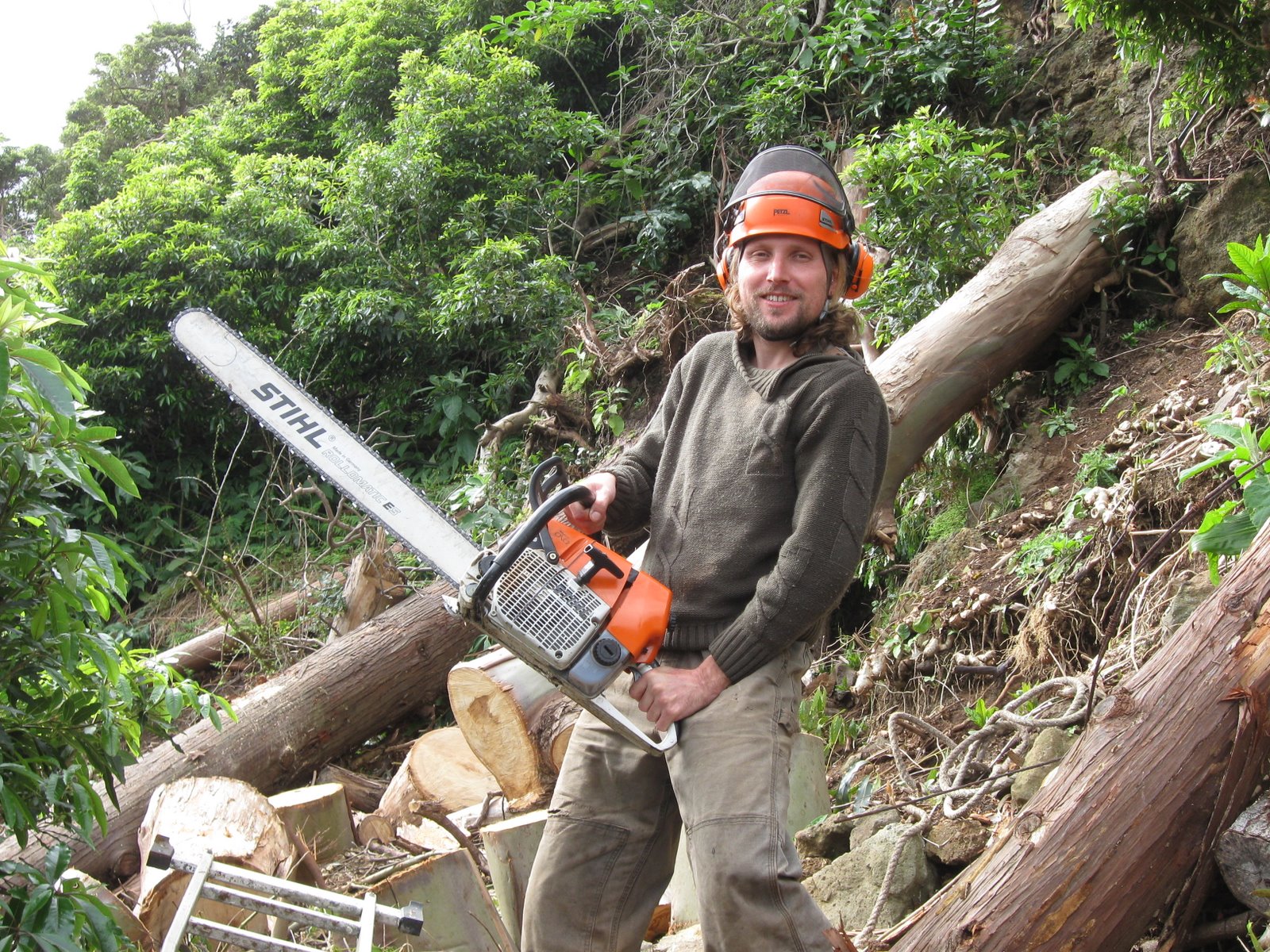
I have been steadily clearing the jungle from our farm for the past few years. The process begins with clearing the underbrush with a machete, so that I can safely navigate the area with a small chainsaw. My favorite chainsaw for land-clearing is the ‘Stihl MS 180’, as it is lightweight, durable and small enough to use in the tight spaces of overgrown jungle. After clearing the underbrush, then the small trees (under 30 cm in diameter) can be cut at ground level and have their limbs removed. The trunks are cut into manageable lengths and laid in piles to dry, while the limbs are piled high to allow the leaves to naturally mulch the forest floor. When all the small trees are felled and organized, then the large chainsaw is brought into play. My choice is the ‘Stihl MS 660’ for felling trees from 35 to 80 cm in diameter. The large trees are dropped, sometimes using a winch to control their fall radius more precisely. I generally want to keep the large trees near to the road so that I can haul them out later to be used for lumber. After all the trees and underbrush have been cleared, then they are allowed to sit for a year to dry. The following summer, a massive bonfire is made that consumes all the wood and destroys new weeds that have begun to sprout in the newly created garden space. This thick layer of charcoal is quickly distributed across the area with a rain shower and the site is ready for planting.
Phase I, after exploring the layout of the land and finding an appropriate site for future gardening, the underbrush must be cleared using a machete.

Phase III of clearing, stacking the small trees to dry in the sun, prior to the bonfire that will add nutrition to the soil.

Having already done these steps the previous year, I took my new suckers and put them to bed in the rich black earth of our mountainside. The remaining tree roots often obscure my choice of locations for planting which aggravates my orderly grid-oriented self. I have learned to embrace the Zen aspect of mountainside gardening and allow the spacing of my banana plants to vary according to the dictates of the terrain. One of the added bonuses to the propagation of Musa sapientum is that they can outgrow the invading weeds and thereby shade the ground below them from future weed germination. In this way, I have an ally in my never ending fight against the invasive and toxic plants that were naively introduced to our island over the years. In the future I can use the banana thickets as an edible wind break and place fragile fruit trees in the center of the patch. Every year, I must remove the new banana suckers and transplant them into newly cleared land; in this way I have an ever expanding ring of weed free and useful garden space!
Phase IV, the planting of the Musa Sapientum clones into the newly cleared mountainside.
Before and After Photos


This year we have been able to harvest our first bunches of bananas. We are experimenting with various recipes from around the world that use green or unripe bananas in place of potatoes in their cuisine. Odin loves the small fruits both ripe or cooked green, which is lucky for him, since he will be eating them for the foreseeable future. I cannot help but sing the ‘Tally me Banana” song whenever I go out to harvest a new bunch.
Phase V, Harvesting of green bananas to ripen inside or be eaten green.

As the herbs grow larger root masses and have ample time to mature, the bunches will develop with more fingers (individual fruits) per hand (groupings of fruits). We are off to a good start though with a fresh supply of ripe and green bananas during the cold days of February. We hope to have an over-abundance in the future to enable us to trade within the village for potatoes, as well as to sell in the local shops that usually import bananas from Central America rather than sell local organically grown produce.

The final advantage we find in growing Bananas rather than potatoes lies in the issue of storage. Whereas potatoes are harvested at one time during the year and stored for later consumption; Banana plants have a staggered fruiting period. This means that we always have a fresh supply of complex carbohydrates on demand year round, still alive and full of Chi! We need only harvest what we need for the week and leave the other bunches to ripen for a sweet desert treat.
Newly transplanted suckers are thriving on our sunny mountainside after the large Eucalyptus trees have been felled and the jungle underbrush cleared.


In total, we have over 100 Banana plants thriving in several patches throughout our properties. Clearly visible in the foreground are the massive trunks from the trees that were felled in previous years; in the distance you can see the invading jungles awaiting their turn with my machete!


 <--see a="" div="" grandadddy="" it.="" of="" on="" photo="" right="" rope="" the="" tied="" to="" with="">